
Balancing risk and safety means designing playgrounds that push older kids within measurable limits. You should anchor growth with data-driven thresholds, supervised autonomy, and clear risk dialogue to adjust difficulty. Use safe challenge progressions that track success rates, time on task, and near-miss indicators, and adjust supports accordingly. Choose accessible materials, durable coatings, and impact-absorbing infills that reduce injury while inviting exploration. If you want practical steps, you’ll uncover more strategies ahead.
How Risk-Taking Builds Resilience in Older Kids
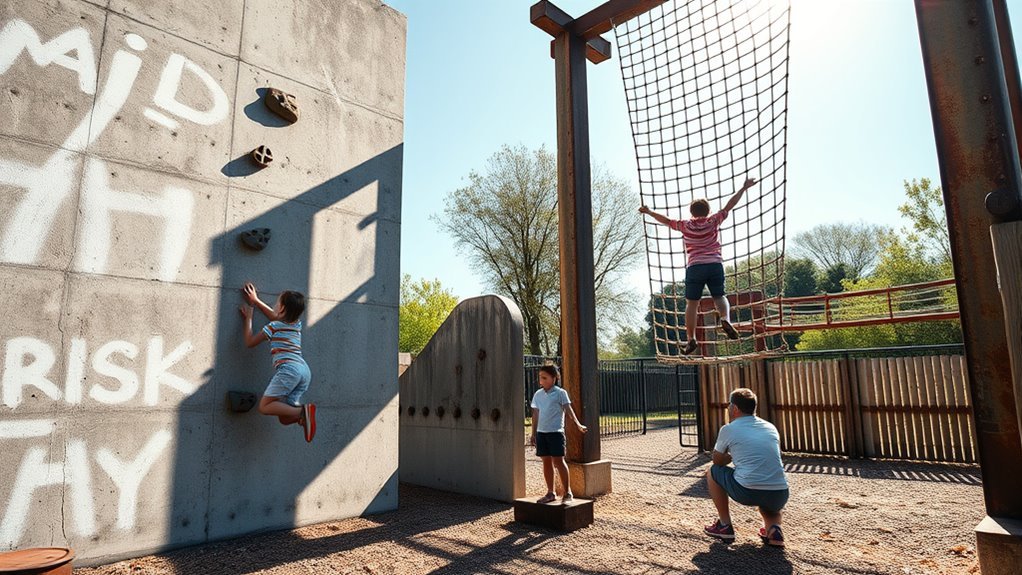
Risk-taking in older kids can build resilience by expanding what they’re capable of handling and learning from setbacks. You’ll notice that carefully guided risk supports better problem solving, as kids test limits in controlled environments. When risk perception is accurate, they assess danger, weigh options, and choose actions that push rather than punish, foster adaptive judgment. Peer learning amplifies this effect: watching teammates navigate challenges helps individuals calibrate their own risk thresholds more reliably than solitary trial and error. Structured opportunities—supervised climbs, timed tasks, and cooperative missions—anchor growth in safety data and feedback. With consistent supports, kids recognize that effort, not perfection, drives progress. This approach cultivate belonging, reduces anxiety about failure, and builds confidence to engage in future, thoughtfully challenging activities.
Scale Play Challenges Safely: Practical Design Principles
You’ll compare safe challenge progressions with measurable thresholds to guarantee escalation stays within proven risk limits. We’ll apply accessible risk techniques to accommodate diverse abilities while maintaining objective safety data and clear guidelines. This discussion sets the groundwork for practical design principles that balance challenge with preventive safeguards.
Safe Challenge Progressions
Safe challenge progressions in scale play mean guiding kids from achievable tasks to more complex ones without exceeding their current abilities. You design with measurable steps, linking each level to clear criteria so progress feels earned rather than risky. Use data-driven benchmarks: success rates, time on task, and fall-proxy indicators to determine when a transition is appropriate. Implement risk budgeting by allocating challenge energy across activities, ensuring total exposure stays within your safety model. Practice challenge scaling by increasing height, distance, or complexity in small, verified increments, with monitoring and adjustable supports. Communicate progress expectations to families, reinforcing a sense of belonging through predictable routines and visible safeguards. Prioritize early return-to-play decisions when performance indicators dip, then recalibrate thoughtfully.
Accessible Risk Techniques
Accessible risk techniques in scale play center on designing measurable, safe pathways that invite challenge without exceeding abilities.
You’ll implement risk dialogue to calibrate user comfort, track feedback, and adjust tasks before escalation. Use clear scalability metrics to quantify intensity, duration, and supervision needs, ensuring options align with developmental stages. A modular layout lets players vary height, speed, and grip while maintaining safety margins. Visual cues and tactile guides support autonomy, reducing uncertainty.
| Pathway | Challenge Level | Monitoring |
|---|---|---|
| Corridor climb | Moderate | Real-time feedback |
| Balancing beam with rails | High | Time and fall-risk data |
| Rope traverse | Moderate-High | Attachment integrity |
| Step ladder rung variation | Low-Moderate | Supervision interval |
| Sloped ramp edge | Moderate | Proximity sensors |
This approach fosters belonging through predictable risk, evidence-based adjustments, and inclusive participation.
Balancing Supervision and Adventure Without Stifling Play
You can balance supervision with adventure by outlining clear, data-backed thresholds for involvement that protect safety without halting exploration. Implement adventure moderation strategies that pair supervision with autonomy, using watchful intervals, check-ins, and escalating risk cues rather than constant control. Engage risk-tolerant play by designing tasks that challenge kids within defined safety margins, ensuring caregivers intervene only when criteria are met.
Supervision Without Restraint
To balance risk and safety, effective supervision should promote rather than restrain kids as they explore challenging playgrounds. You guide, observe, and intervene only when needed, preserving autonomy while reducing harm. Clear roles, structured sightlines, and timely prompts shape safe exploration without dampening curiosity. Data show supervision that pairs proximity with trust sustains engagement and reduces risky incidents, especially when kids understand expected behaviors. Emphasize inclusion by using language that invites collaboration and ownership of safety decisions, fostering belonging as they test limits. Use prevention-focused routines, rapid hazard audits, and accessible reporting channels to sustain momentum. Supervision strategies should include preparation, communication, and adaptive monitoring, while offering risk free alternatives when appropriate to maintain confidence and progress.
- Proximity-enabled autonomy
- Timely, specific prompts
- Consistent safety expectations
- Risk-free alternatives before escalation
Adventure Moderation Strategies
Adventure moderation blends vigilant supervision with room for exploration, ensuring kids push boundaries safely rather than retreat from them. You balance observation with autonomy, guided by risk assessment and clear safety thresholds. You establish move-fast, move-slow zones, monitor loads, and enforce gradual challenge progression to prevent stalls in development. Regular equipment maintenance underpins trust, reducing surprises during play. Data-informed checklists guide decisions, ensuring interventions stay proportional to observed risk. You cultivate an environment where kids learn risk appraisal while maintaining inclusion and belonging. Clear communication about boundaries, roles, and purpose reinforces confidence. Collaboration with families and staff strengthens consistency. This approach sustains engagement and safety, enabling adventurous testing within pre-defined limits.
Engaging Risk-Tolerant Play
Even with close supervision, offering risk-tolerant play requires intentional balance: keep a steady eye on safety cues while granting opportunities for challenging, goal-oriented exploration. You’ll design activities that provoke problem-solving and persistence, then measure outcomes with practical risk assessment methods to confirm safe progress. Communicate clearly with caregivers and kids to normalize risk as a constructive element. You’ll adapt your supervision to the terrain, equipment, and skill levels, reducing barriers while preserving challenge. Transparent risk communication helps set expectations, reduces anxiety, and builds trust. Build routines that document incidents, near-misses, and improvements, guiding continuous refinements. This approach supports belonging by valuing competence, autonomy, and shared responsibility.
- Align challenges with assessed abilities
- Record and review risk data consistently
- Frame risk as learning opportunities
- Engage families in ongoing dialogue
Safe, Exciting Materials and Surfaces for Modern Playgrounds
Modern playground surfaces and materials should prioritize safety without compromising involvement; selecting impact-absorbing infills, resilient composites, and durable, low-maintenance coatings reduces injury risk while maintaining age-appropriate challenge. You’ll prioritize bystander engagement and noise management, so paths, mats, and softened edges invite collaboration without fatigue or distraction. Data show lower injury rates when surfaces meet standardized impact criteria and coatings resist wear. You’ll choose modular, color-stable components that endure weather and UV exposure, enabling predictable performance year after year. In practice, test a small fleet of surfaces, monitor grip and drainage, and adjust layouts to minimize congestion.
| Material | Benefit | Concern |
|---|---|---|
| Infills | Impact absorption | Dust potential |
| Coatings | Durability | Slip risk |
| Composites | Strength | Weight considerations |
How to Measure Safety, Engagement, and Learning Outcomes

Measuring safety, involvement, and learning outcomes in playground design builds on the safety-first materials and surfaces we’ve outlined, but focuses on observable results and practical benchmarks. You’ll rely on structured risk assessment data, standardized play measurement tools, and direct observer notes to quantify engagement, challenge tolerance, and skill transfer. Track incidents, near-misses, and time-to-peak participation to identify design gaps, then adjust features accordingly. Data-driven reviews ensure decisions balance safety with meaningful risk, fostering belonging through inclusive, challenging play. Communicate results with stakeholders using clear metrics and transparent thresholds for action.
Measurable safety and growth through data-driven playground design and inclusive, challenging play.
- Risk assessment thresholds guide feature iteration and safety controls
- Play measurement tracks engagement, duration, and skill development
- Comparative benchmarks reveal improvements and regressions
- Transparent dashboards build trust among communities and families
Step-by-Step Community Implementation Plan
How can we translate our safety-first framework into tangible, community-ready steps? You’ll outline a step-by-step plan that pairs risk assessment with practical action, engaging stakeholders from the start. Begin with a clear baseline: document current playground usage, injury incidents, and access needs to guide prevention priorities. Next, integrate community alignment by hosting inclusive forums, surveys, and beta-testing groups to gather diverse perspectives and build ownership. Translate findings into measurable milestones: policy updates, redesigned equipment specs, and maintenance schedules with accountability metrics. Establish governance roles, transparent timelines, and budget traces to sustain momentum. Finally, implement iterative reviews, monitor safety indicators, and share progress openly to reinforce belonging, trust, and shared responsibility across residents, schools, and parks departments.
Frequently Asked Questions
How Can Risk-Taking Be Tailored to Diverse Abilities?
You can tailor risk by evaluating abilities through inclusive challenges, adjusting difficulty, and providing adaptable options; you’ll map progress with clear data, inviting everyone to participate. Risk tailoring respects differences, nurtures belonging, and reduces harm through thoughtful progression.
What Role Do Parents Play in Supporting Safe Adventures?
Parents support your child’s safe adventures by setting clear guidelines, supervising appropriately, and encouraging gradual risk-taking through adventure learning. You tailor challenges to abilities, monitor progress, and reinforce preventive habits to build confidence and inclusive belonging.
How to Budget for Durable, Challenging Playground Features?
You budget durability, cost planning and funding, then design challenges, materials longevity; you budget durability, cost planning and funding, then design challenges, materials longevity. You justify upkeep, anticipate failure points, and align funding with shared goals and belonging.
Can Digital or Tech Elements Enhance Risk Education?
Yes, tech simulations and risk gamification can enhance risk education, you’ll engage learners with data-driven feedback, track progress, and foster belonging, as precise metrics and safe challenges help you calibrate difficulty and improve protective decision-making.
How to Measure Long-Term Community Impact Beyond Safety Metrics?
You’ll measure long term impact by tracking indicators like sustained participation and program reach, correlating them with community engage metrics, and using longitudinal surveys to reveal trends that indicate lasting social benefits beyond safety alone.