
You should center traditional Indian games in modern playground design as they offer inclusive, low‑cost models rooted in community memory and seasonal rhythms. They teach team coordination, spatial awareness, and fine motor skills through vocal cues, low stances, and simple handheld elements. Modular, locally sourced materials invite repair, improvisation, and multi‑generational use, fostering belonging and cultural continuity. These approaches make play equitable, sustainable, and educational—keep going to see practical layouts, materials, and prototyping steps.
Why Traditional Indian Games Matter for Playground Design
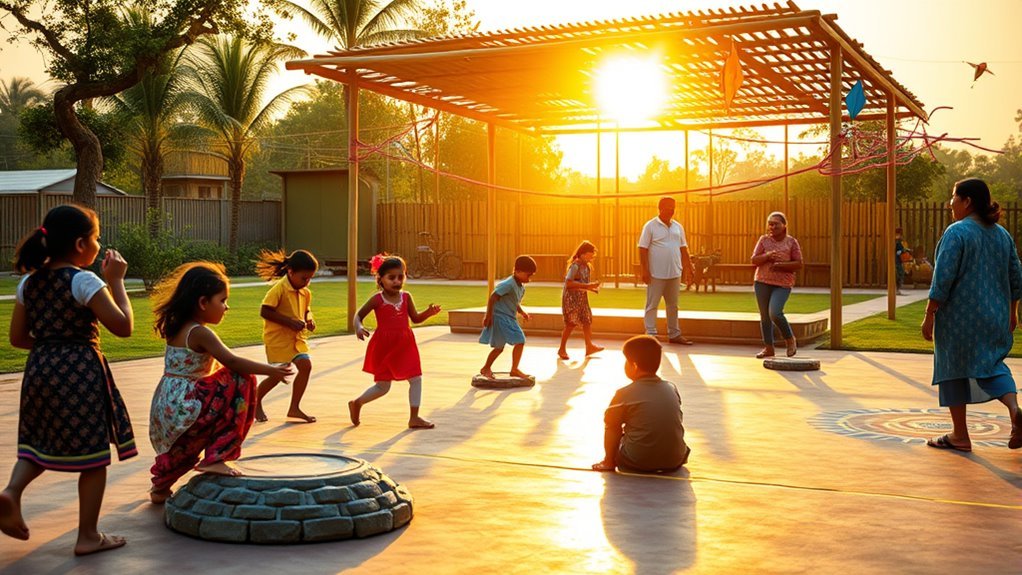
Why should playgrounds, often modeled on Western templates, look to traditional Indian games for guidance? You’ll find that indigenous play traditions offer nuanced frameworks for inclusive, resource-light design rooted in community values. When you consider local materials, seasonal rhythms, and multi-generational participation, playgrounds can replace the first verb with an alternative contextually relevant term to replace only these word(s): dive, foster, dive, validate. You’ll appreciate games that invite adaptability, cooperative rule-making, and spatial improvisation—qualities that challenge one-size-fits-all standards. Designing with these practices in mind strengthens cultural continuity, validates childhood memories, and invites diverse bodies and abilities into shared play. By centering local narratives and practices, you’ll create spaces where children and caregivers see themselves reflected, participate confidently, and co-create playful environments that sustain social ties and intergenerational learning.
Social, Spatial, and Motor Skills to Borrow From Kho-Kho, Gilli-Danda, and Kancha
You’ll find in Kho-Kho clear team coordination cues that can inform equipment that signals roles and timing. Exercises drawn from these games sharpen spatial awareness through dynamic boundaries and movement corridors. Simple handheld elements inspired by Gilli-Danda and Kancha can promote fine motor precision while honoring cultural play forms.
Team Coordination Cues
How do traditional Indian games teach teams to move, read, and respond as a unit? You learn cues—calls, glances, footwork—that bind players into a shared rhythm. In kho-kho, vocal signals and low stances cue collective pursuit; in gilli-danda, timing and position communicate risk; in kancha, subtle hand placement and gaze coordinate retrieval. You pick up social rules that build trust, spatial roles that reduce collision, and motor patterns that sync effort.
| Cue Type | Example Use |
|---|---|
| Vocal | Kho-kho shouts to initiate chase |
| Gaze/Body | Kancha eye contact for handoffs |
| Timing/Motor | Gilli-danda cadence for strikes |
Designing modern equipment with these cues fosters belonging, cooperation, and culturally rooted play.
Spatial Awareness Drills
Building on team coordination cues, spatial awareness drills translate calls, glances, and footwork into repeatable exercises that sharpen where players place themselves, how they read moving teammates, and when they commit to action. You’ll practice flowing formations inspired by kho-kho’s chasing lanes, learning to occupy corridors and yield space without collision. Simple circle and scattering patterns from kancha train peripheral vision and judgment of trajectory; you’ll know when to close gaps or create them for others. Gilli-danda’s quick resets suggest short, rhythmic intervals that improve repositioning speed and shared timing. These drills emphasize collective sensing over individual brilliance, so you’ll feel included while developing trust, anticipation, and respect for embodied cultural strategies. Equipments should support sight-lines, safe spacing, and unobstructed movement.
Fine Motor Precision
Why does touch matter as much as trajectory in traditional Indian games? You learn precision by feeling: the subtleties of stick, stone, or marble contact teach nuanced grip, release, and timing that modern gear often overlooks. These skills build social rituals and communal confidence, letting you belong through shared mastery.
| Game | Fine Motor Task | Social Context |
|---|---|---|
| Gilli-Danda | Flicking small timber with controlled wrist | Paired rivalry, mentorship |
| Kancha | Aiming marbles with thumb flick | Circles of kin and neighborhood peers |
| Kho-Kho | Tagger’s palm tap & evasive hand feints | Team coordination, trust building |
Designers should borrow tactile variability to foster(d) dexterity, cultural continuity, and cooperative play that respects tradition while serving today’s children.
Design Principles: Modularity, Improvisation, Low-Cost Materials
Although rooted in local materials and improvisation, traditional Indian games embody design principles that are immediately relevant to contemporary play equipment: modular components, adaptability to varied spaces, and use of low-cost, sustainable materials that invite repair and reuse. You’ll recognize how modularity lets parts be recombined for different games and age groups, creating inclusivity without exclusivity. Improvisation teaches you to see constraints as creative prompts, so equipment can be multifunctional and culturally resonant. Low-cost materials lower barriers to entry, nurturing community ownership and shared stewardship. As a designer or caregiver, you’re invited to prioritize systems that encourage collective maintenance, playful experimentation, and subtle cultural continuity—so every child feels both challenged and welcomed in the play environment.
Materials and Modular Builds for Sustainable, Accessible Play
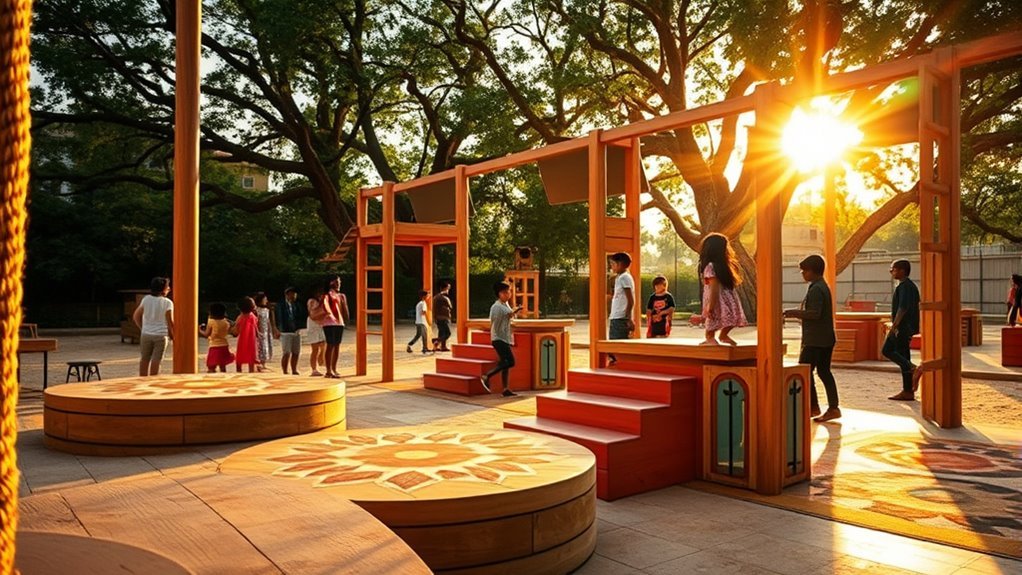
Moving from principles of modularity and improvisation, consider how specific materials and joinery make sustainable, accessible play equipment viable in diverse Indian settings. You’ll favor locally sourced timber, bamboo, recycled plastics, and treated jute for durability, low cost, and cultural resonance. Simple joinery—mortise-and-tenon, lashing, interlocking slats—lets communities assemble, repair, and adapt modules without specialized tools. Use non-toxic finishes and UV-stable treatments to protect surfaces while honoring traditional aesthetics. Design connectors to be hand-manipulable yet secure, so caregivers and children can co-create configurations. Encourage community workshops that teach maintenance and safe assembly, creating ownership and skills transfer. By choosing materials and modular systems this way, you’ll promote inclusive play that’s resilient, repairable, and rooted in local knowledge.
Layouts and Features That Welcome All Ages and Abilities
How might layouts and features be arranged so play spaces feel inviting and usable for a wide range of ages, abilities, and cultural practices? You’ll design gradients of challenge—quiet sensory zones, low-impact movement areas, and skilled-play hubs—so people move fluidly between solitude and sociality. Incorporate braille, tactile paths, and visual contrast alongside flexible seating and stepping elements that accommodate walkers or wheelchairs. Use culturally resonant motifs and modular game markings that elders recognize and children reinterpret, encouraging intergenerational exchange. Ensure surfaces reduce fall risk and auditory cues support wayfinding without overwhelming. Signage uses multiple languages and pictograms, honoring linguistic diversity. By centering choice, safety, and cultural memory, you’ll create play landscapes where everyone can participate, contribute, and belong.
Case Studies and Rapid Prototyping Steps for Designers
What kinds of small-scale experiments will show whether traditional Indian game motifs truly improve modern play spaces? You’ll design case studies that pair prototype elements—kolam-patterned stepping stones, kho-kho-inspired chase lines, or gilli-danda balance beams—with control zones. Use mixed methods: observe play patterns, measure engagement duration, and gather short interviews from kids, caregivers, and community elders to capture cultural resonance. Rapid prototyping steps include low-cost mockups, iterative user testing, and co-design sessions with local stakeholders. Document failures and adaptations, note accessibility outcomes, and quantify social interactions. You’ll prioritize ethical, inclusive practices, ensuring prototypes reflect community histories. These focused trials let you refine designs that foster belonging, sustain cultural memory, and enhance playful learning.
Frequently Asked Questions
How Can Traditional Games Be Adapted for Indoor Play Spaces?
You can adapt traditional games by scaling rules, using softer materials, creating modular equipment, and embedding stories and cultural cues so children feel included, fostering cooperative play, cognitive challenges, and safe sensory experiences that honor heritage and community.
Are There Safety Standards for Improvised, Low-Cost Playground Equipment?
Yes—you should follow safety standards like ASTM, CPSC guidelines, and local codes even for improvised low-cost equipment; investigating evidence shows risk reduction, so adapt materials, supervise, and document maintenance for inclusive, culturally respectful play.
How Do We Measure Long-Term Behavioral Impacts of Culturally-Based Play?
You’d measure long-term behavioral impacts through mixed-method longitudinal studies, combining repeated observations, culturally-sensitive validated surveys, peer and caregiver interviews, and participatory reflection, tracking social cohesion, identity formation, play patterns, and well-being across developmental stages.
Can Traditional Game Elements Be Integrated Into Digital Play Platforms?
Yes — integrating traditional game elements into digital platforms is feasible and effective: you’ll rigorously test authenticity, adapt mechanics for screen play, honor cultural meanings, promote inclusive communities, and iteratively assess impacts on learning, identity, and social belonging.
What Funding Sources Support Community-Led Traditional Play Projects?
You can tap government cultural and sports grants, local NGOs, community crowdfunding, corporate CSR funds, and international cultural preservation grants; you’ll also find university partnerships and foundation awards that value inclusive, play-centered, community-led heritage projects.